

by Anthony Segura
The first time I met 3-year-old Lincoln and his mother, I didn’t get a smile. Instead, it was hesitation. His mother walked past me, turned to my paraprofessional, and asked in Spanish, “¿Eres la maestra?” (“Are you the teacher?”) When my colleague pointed toward me and said, “The teacher is Mr. Anthony,” her face fell like a quarter in water. She said, “No quiero que mi hijo tenga un maestro.” (“I don’t want my son to have a male teacher.”)
That moment revealed a truth we rarely confront: Our youngest learners rarely see men in teaching roles. In my school district, I am one of a few male early education teachers. Nationally, only 2.5% of preschool and kindergarten teachers are male. Those numbers reflect more than a workforce gap and are a missed opportunity for young children to see male teachers as role models.
As a preschool teacher in a predominantly Hispanic, low-income community, I have seen the impact male educators like me can have. Many of my students rarely see their fathers, who are often working two jobs. One mother said it best: “It means so much for my son to have a teacher who looks like him and is male.” Her words capture why representation in the classroom matters as much as curriculum or resources.
Research backs up what parents feel. Studies show that young children benefit academically, socially and emotionally when exposed to educators of different genders, backgrounds and life experiences. Diverse teachers help students develop broader understandings of relationships, identity and empathy.
To shift that reality, we need targeted mentorship and scholarship programs that make early education a visible and supported pathway for men. I’ve had the privilege of mentoring both male and female educators, and several women have shared that having a male mentor brought a valuable perspective that challenged stereotypes about who can nurture and teach young children. Mentorship for me provides a pathway of visibility and shows men that early education is not only a space where they are needed, but a space where our strengths, care and perspectives matter.
Another critical piece is building strong partnerships between school districts, teacher preparation programs, community colleges and local organizations to recruit male educators who reflect the communities our children come from. Many future educators are already in our communities working in after-school programs, volunteering in classrooms, or leading on the playground. When districts collaborate with local institutions to recruit diverse male candidates early, they intentionally expand the pipeline. Through a program at California State University Northridge (CSUN), I was able to complete my master’s degree and obtain my credential. I was also paired with Los Angeles Unified School District (LAUSD) and guaranteed a job as a preschool special education teacher.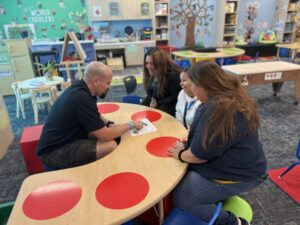
We can’t recruit or retain more men in early education without addressing sustained public to investment in debt-free pathways into the profession. Many talented paraprofessionals and college students who love working with young children are pushed out by the cost of preparation. My program at CSUN was entirely paid for, which not only took off the stress of having tuition debt but also inspired me and gave me the confidence to pursue a career I love. In recent years, the state has taken important steps through short-term grant programs like the Golden State Teacher Grant Program and the Classified School Employee Teacher Credentialing Program. As the governor and the Legislature prepare the next state budget, they must continue investing in such programs so affordable, high-quality pathways into education become the norm.
A few months after Lincoln left my class, his mom returned. She looked at me and said, “Quiero un macho en la vida de mi hijo porque no tiene uno en casa” (“I want a man in my son’s life because he doesn’t have one at home.”) This moment was about what my presence as a male educator symbolized. Every child deserves to see patience and strength modeled by both women and men. There is a Lincoln in every school waiting to see that learning, compassion and possibility come in all forms, including someone who looks like Mr. Anthony.
January 26, 2026
Anthony Segura is a preschool special education teacher at Rose Salgado Elementary in San Jacinto, California. He is a 2025-26 Teach Plus California Senior Policy Fellow.